RainODE: Continuous-Time Precipitation Forecasting with Latent Neural ODEs
KAIST
*Equal contribution. †Corresponding author.
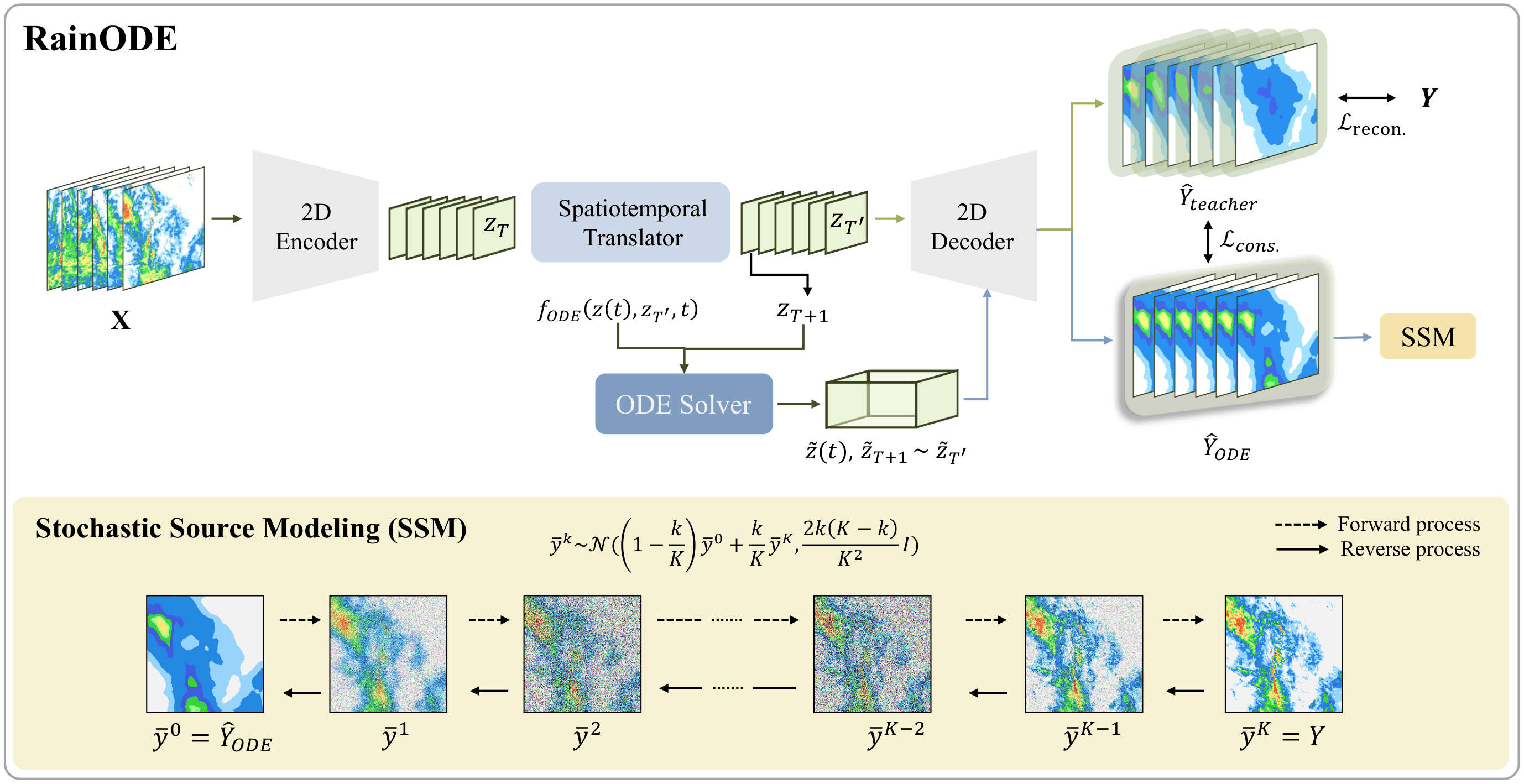
RainODE models precipitation evolution as continuous-time latent dynamics and supports arbitrary-time inference.
Abstract
In precipitation forecasting, increasing temporal resolution is constrained by observational limitations and the computational cost of dense discrete modeling. To overcome this limitation, we reformulate precipitation forecasting as a continuous-time dynamical system and propose RainODE, a framework that models precipitation evolution in latent space using a Neural ODE. To represent non-advective intensity changes, we introduce a stochastic source modeling module based on a Brownian Bridge formulation. Experiments on SEVIR and RAPID demonstrate consistent improvements across multiple temporal intervals.
Main Results
RainODE achieves strong performance on both SEVIR and RAPID. On SEVIR, it preserves spatial alignment while maintaining sharper precipitation intensity. On RAPID-60min, RainODE shows more coherent long-horizon forecasts compared with discrete and generative baselines.
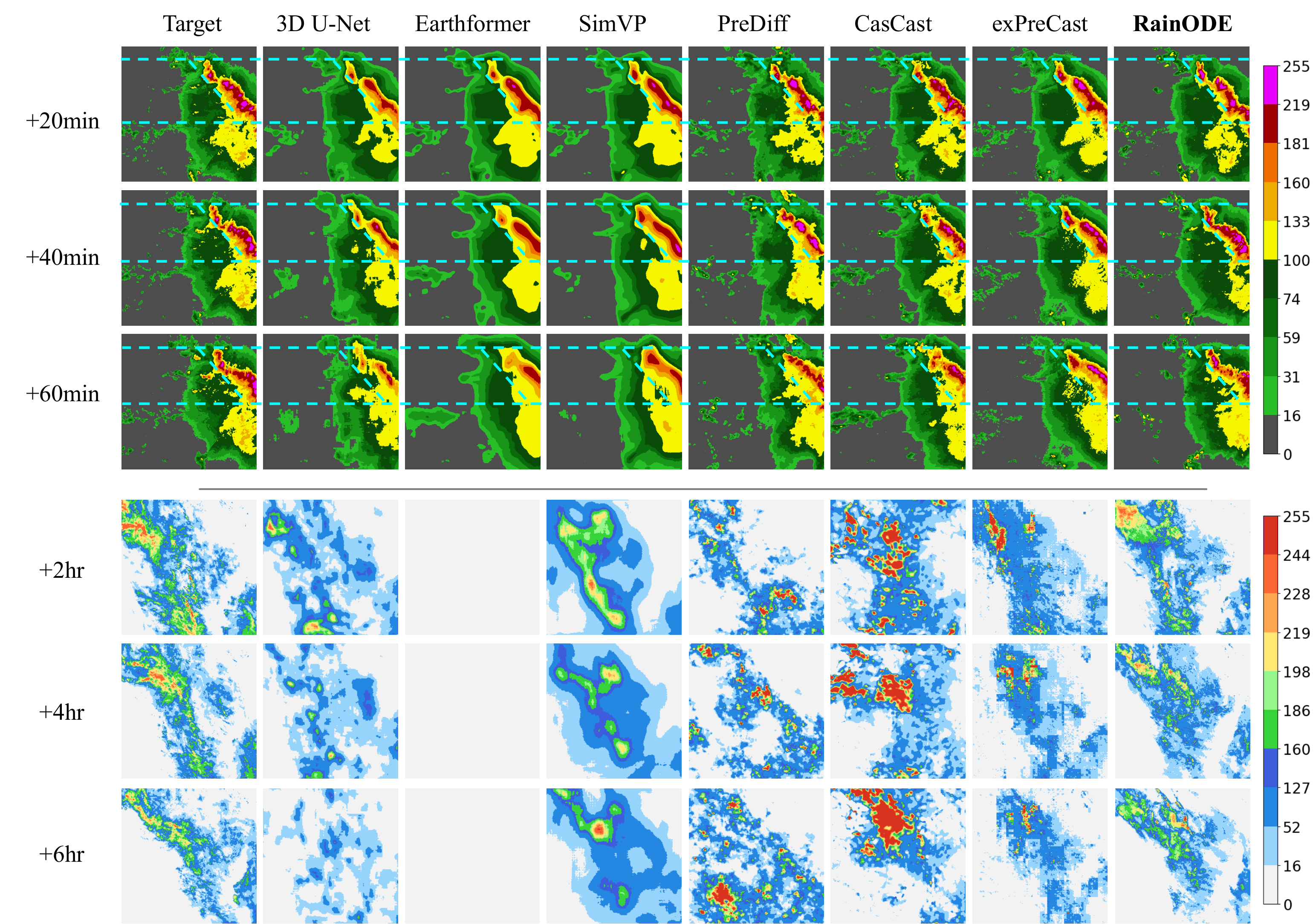
RainODE better aligns precipitation location and intensity across short- and long-horizon forecasting settings.
Continuous-Time Forecasting
RainODE supports dense temporal inference by querying continuous latent dynamics at arbitrary time points. Unlike discrete forecasting models, it can generate intermediate forecasts without retraining or autoregressive rollout.
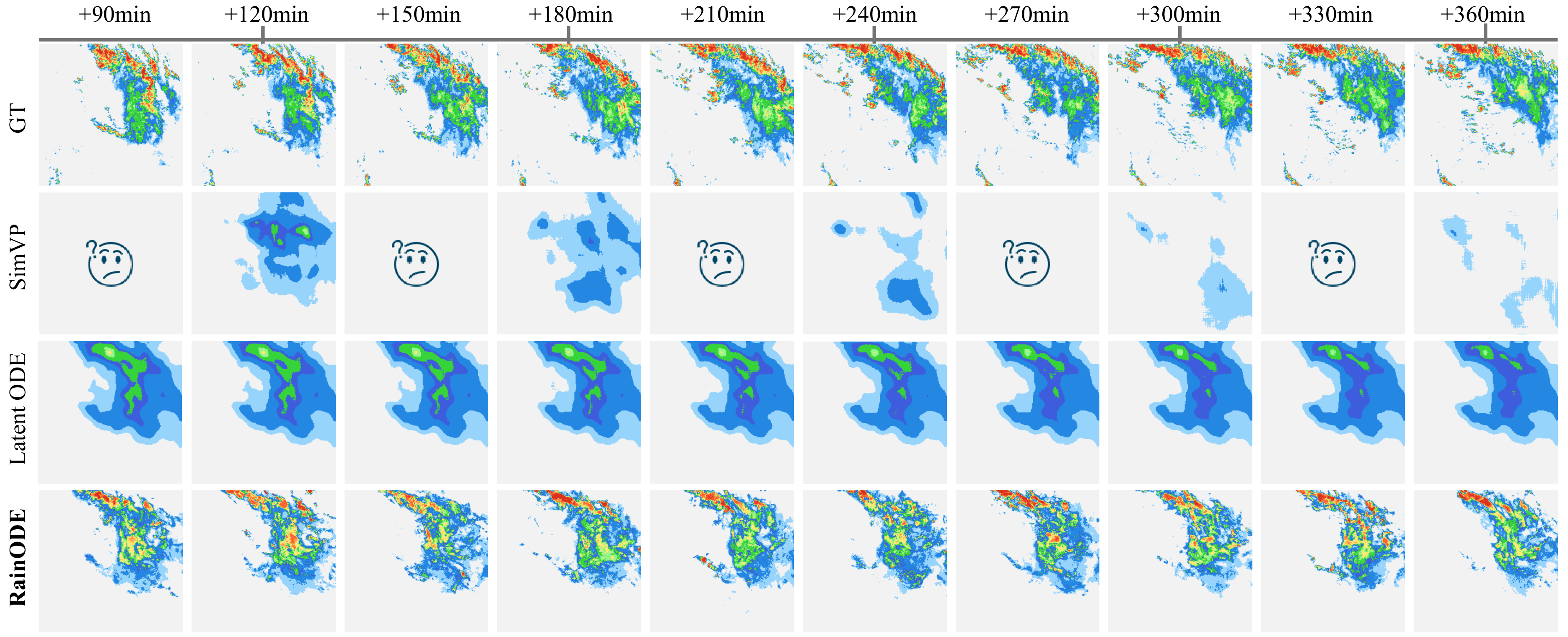
RainODE produces coherent forecasts up to +360 minutes, while discrete baselines are restricted to predefined timestamps or suffer from long-horizon degradation.
Latent Trajectory Analysis
We further visualize latent-space trajectories to analyze temporal consistency. RainODE exhibits smoother and more coherent progression across lead times, suggesting stable continuous-time evolution in the learned representation space.
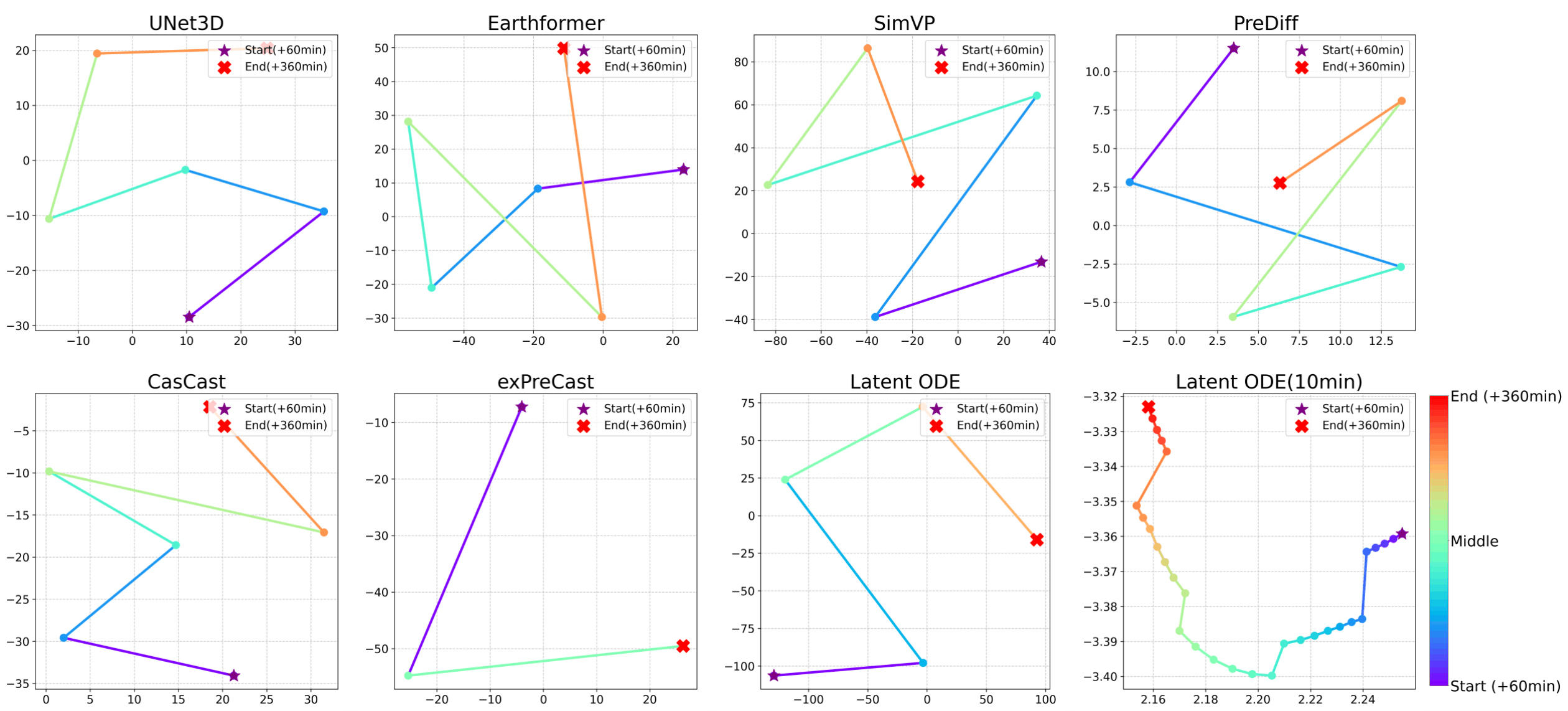
Compared with discrete-time baselines, Latent ODE shows a more coherent trajectory from the initial forecast time to the final horizon.